
iPhone 18 Pro: Why Apple Tripled the Vapor Chamber — and What It Means for Thermal Engineering
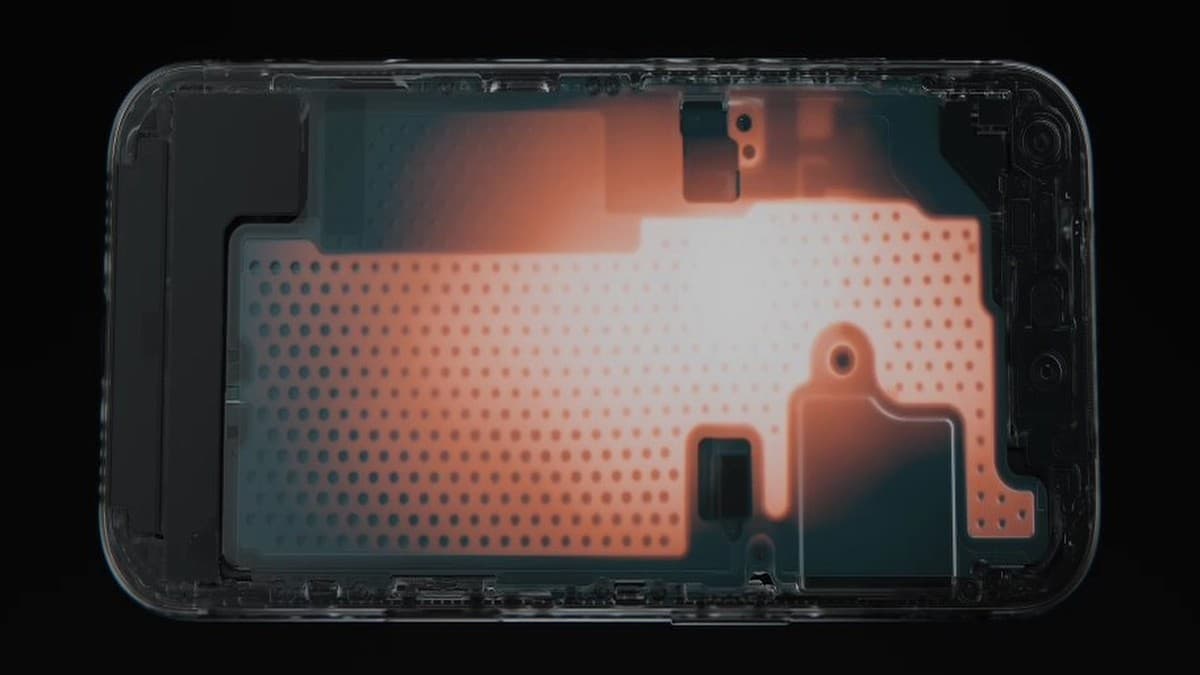
Apple's latest flagship isn't just faster — it's cooler. Literally.
By tripling the vapor chamber surface area and mounting the A20 Pro chip directly onto it, Apple achieved a 40% increase in sustained performance — the highest in iPhone history. That's not a spec bump — that's a thermal architecture redesign.
Vapor chambers in smartphones are nothing new — Samsung, Xiaomi, and Apple themselves have used them for several device generations. What sets the iPhone 18 Pro apart: Apple fundamentally redesigned the A20 Pro chip packaging, inspired by the M-series architecture from the Mac lineup. The memory now sits beside rather than on top of the silicon die, removing it from the chip's thermal path. Only this made the direct coupling of the chip to a next-generation vapor chamber possible — with three times more surface area than the previous iPhone 17 Pro.
The Principle: Two-Phase Cooling
The physics behind Apple's solution are exactly the same ones we apply daily at ALVC Europe on an industrial scale: A working fluid evaporates at the hot spot, transports heat as vapor to the cooler side, condenses there, and flows back. This closed loop — without moving parts, without external energy — is the most efficient passive cooling method physics has to offer.
What Apple solves at the millimeter scale, we scale to industrial format:
- Vapor chambers as thin as 0.3 mm for compact power electronics
- Gravity-driven thermosyphon systems for control cabinets and data centers dissipating up to 10 kW
- IGBT thermal management for inverters, traction drives, and energy storage systems
What This Means for Industrial Applications
Apple's decision underscores a trend that has been evident in power electronics for years: Beyond a local heat flux density of approximately 30–50 W/cm², conventional aluminum heat sinks and simple heat pipes reach their limits — spreading resistance becomes too high and junction temperatures exceed allowable thresholds.
Vapor chambers solve precisely this problem: Through planar evaporation, heat is distributed nearly isothermally across the entire spreading surface. In IGBT modules, SiC power semiconductors, and HPC servers — wherever power loss density is increasing — two-phase technology is already the technically superior solution.
Particularly relevant is Apple's approach of removing the memory from the thermal path and coupling the chip directly to the vapor chamber. In industrial electronics, this principle — minimizing thermal boundary layers between heat source and heat spreader — has long been a key lever for performance improvement. ALVC implements this in custom solutions with direct die-attach coupling and tailored evaporator geometries.
Note: ALVC Europe is not the thermal supplier for the iPhone. We share this analysis to highlight the growing importance of two-phase cooling across industries.
Source: Apple Newsroom — iPhone 18 Pro